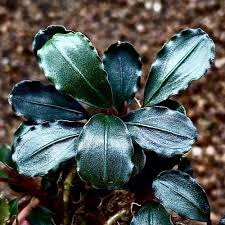
Bucephalandra sp. ‘Batang Kawa’ is a rare, slow-growing epiphytic aquarium plant native to the Batang Kawa district in Central Kalimantan, Borneo. It belongs to the Araceae family and is highly prized in aquascaping for its unique metallic sheen, wavy elliptic leaves, and compact growth habit. Under optimal aquarium lighting, its deep green foliage exhibits striking shades of blue, purple, and brown-red tones on young shoots. Indeed, aquarists value Bucephalandra sp. ‘Batang Kawa’ for its unusual coloration and texture.
Key Characteristics:
- Appearance: Resembles the popular “Brownie” forms. It features small, elongated, or elliptic leaves with distinct wavy margins, making Bucephalandra sp. ‘Batang Kawa’ particularly recognizable among aquatic plants.
- Visual Appeal: The leaves showcase tiny iridescent white spots that glimmer under high-quality LED lights, and these visual features make Bucephalandra sp. ‘Batang Kawa’ stunning in display tanks.
- Versatility: It can be grown fully submerged in aquariums or emersed in high-humidity setups like terrariums, paludariums, and Wabi-Kusa. As a result, Bucephalandra sp. ‘Batang Kawa’ adapts easily to various aquascaping layouts.
- Size: Stays small and compact (typically up to 5–10 cm in height), making it ideal for nano aquariums or fine hardscape detailing with Bucephalandra sp. ‘Batang Kawa’ creating a refined texture.
Ideal Water Parameters & Care:
This plant is incredibly hardy and tolerant of a wide range of tank environments, making it a great choice for both beginners and experts. Notably, even under varied conditions, Bucephalandra sp. ‘Batang Kawa’ thrives with steady care.
- Temperature: 22°C – 28°C
- pH Level: 6.0 – 7.5 (Slightly acidic to neutral preferred)
- Water Hardness: Soft to moderately hard (GH 5–15 °d)
- Lighting: Low to Medium (High light intensifies colors but risks algae growth)
- CO₂ Demand: Low / Optional (Not required, but beneficial for growth and color in Bucephalandra sp. ‘Batang Kawa’ with additional CO₂).
- Growth Rate: Extremely slow (roughly 1–3 new leaves per month for Bucephalandra sp. ‘Batang Kawa’ under optimal conditions)
Planting & Propagation Guide:
- Do Not Bury the Rhizome: Never plant the horizontal thick stem (rhizome) into substrate or soil. Doing so cuts off oxygen flow and will cause the plant to rot and die. This is critical, especially for Bucephalandra sp. ‘Batang Kawa’, which is sensitive to rhizome damage.
- Hardscape Attachment: Secure the plant to driftwood, lava rocks, or aquarium decorations. You can use cyanoacrylate gel (aquarium-safe super glue), tie it down with sewing thread/fishing line, or wedge it firmly into tight crevices. Many aquarists attach Bucephalandra sp. ‘Batang Kawa’ this way to maximize health and display.
- Water Flow: In its natural habitat, it grows in fast-moving rainforest streams. It thrives when placed in areas of the tank with moderate water movement, which also keeps debris from settling on its leaves—an essential part of caring for Bucephalandra sp. ‘Batang Kawa’.
- Nutrient Intake: It feeds primarily from the water column rather than roots. Regular dosing of an all-in-one liquid fertilizer—especially iron—will bring out its deep blues and purples, a signature of healthy Bucephalandra sp. ‘Batang Kawa’ specimens.
- Propagation: Easily propagate the plant by using a sharp blade to cut the rhizome. Ensure each split piece has at least 3 leaves and a few healthy roots before re-attaching it elsewhere for new Bucephalandra sp. ‘Batang Kawa’ growth.
Troubleshooting: The ‘Buce Melt’:
If you introduce ‘Batang Kawa’ into your aquarium and it begins losing its leaves, do not panic or discard it. It is common for Bucephalandra to undergo “melt-back” when transitioning to new water conditions or shifting from emersed tissue cultures to submersed environments. As long as the rhizome remains firm and green, keep it in place; it will adapt and sprout new, resilient submersed leaves within a few weeks. In time, Bucephalandra sp. ‘Batang Kawa’ will recover and flourish.




Reviews
There are no reviews yet.