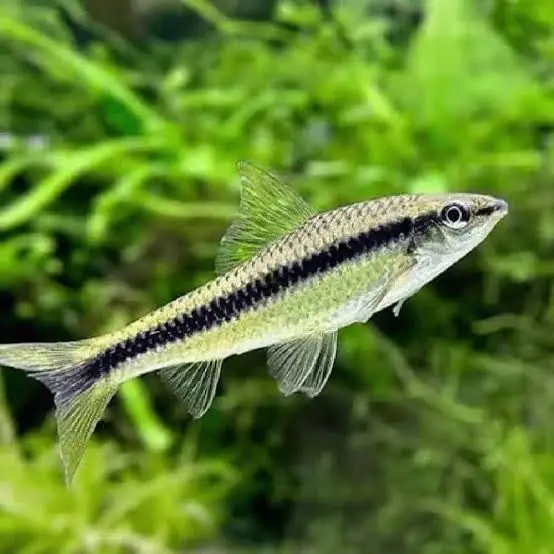
- The Siamese Algae Eater (SAE), scientifically known as Crossocheilus siamensis, is one of the most highly regarded freshwater utility fish in the aquarium hobby. They are famous for their peaceful nature and their unique willingness to consume Black Beard Algae (BBA) and hair algae, which most other fish refuse to touch.
The Siamese Algae Eater (SAE), scientifically known as Crossocheilus siamensis, is one of the most highly regarded freshwater utility fish in the aquarium hobby. They are famous for their peaceful nature and their unique willingness to consume Black Beard Algae (BBA) and hair algae. Most other fish refuse to touch these types.
Identification: True SAE vs. Lookalikes:
The Horizontal Stripe: A single, ragged black stripe runs from the nose completely through to the very edge of the tail fin.
- Clear Fins: All fins (dorsal, pectoral, anal, and tail) are completely clear and transparent, lacking any black or red tints.
- Mouth Parts: They have a pointed face with one small pair of whiskers (barbels) near the mouth, not a large round suction cup.
Common Impostors to Avoid:
- Flying Fox (Epalzeorhynchos kalopterus): Features a distinct gold line above the black stripe, and its fins display dark or reddish outlines. They become territorial and aggressive as they mature.
- Chinese Algae Eater (Gyrinocheilus aymonieri): Identified by a large, distinct sucker mouth and a jagged or bumpy line along its side. They stop eating algae as adults, grow up to 11 inches, and will attack tank mates to suck on their slime coats.
Tank Setup & Care Requirements:
While easy enough for beginners, they have specific long-term space and swimming needs.
- Tank Size: A minimum of 45 litres is required for a single juvenile, but a 40-gallon (150-litre) tank or larger is highly recommended. They are active, fast-swimming fish that grow up to 15 cm long.
- Water Parameters: They prefer a temperature range of 22–27°C, a pH between 6.0 and 7.5, and clean, well-oxygenated water with low nitrates.
- Aquarium Decor: A lid or tight-fitting cover is essential because SAEs are notorious jumpers. Provide a heavily planted environment with driftwood for security and resting spots.
Diet & Feeding Habits:
Though praised for their algae-eating efficiency, they cannot survive on aquarium algae alone.
- Algae Control: They clean hair algae, brush algae, diatoms, and macroalgae off leaves and decorations without damaging the plants.
- Supplemental Diet: Supplement their food 2–3 times a week with sinking algae wafers, high-quality pellets, and blanched vegetables like zucchini or cucumber.
Temperament & Tank Mates:
SAEs are generally incredibly peaceful, schooling fish. They are best kept either singly or in groups of 5 or more. Keeping them in pairs or trios can sometimes lead to territorial chasing among themselves.
They are excellent candidates for community tanks housing tetras, rasboras, Corydoras, and peaceful dwarf cichlids. However, because they are incredibly energetic and dart around the tank rapidly, their fast movements can sometimes stress out very slow-moving or timid fish like Discus or senior Gouramis.


Reviews
There are no reviews yet.