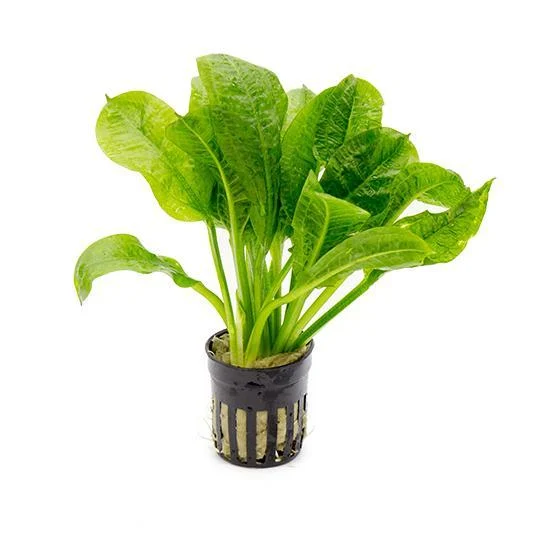
Echinodorus grisebachii ‘Parviflorus’ is commonly known as the Black Amazon Swordplant or Echinodorus peruensis, is a highly popular, compact, and hardy freshwater aquarium plant. Native to the Amazon region of Peru and Bolivia, it is a smaller wild-type variant of the standard Amazon Sword (Echinodorus grisebachii).
Echinodorus grisebachii ‘Parviflorus’ is commonly known as the Black Amazon Swordplant or Echinodorus peruensis, is a highly popular, compact, and hardy freshwater aquarium plant. Native to the Amazon region of Peru and Bolivia, it is a smaller wild-type variant of the standard Amazon Sword (Echinodorus grisebachii).
This plant is highly valued by aquarists because it remains much smaller and is significantly less light-demanding than its massive cousins, Echinodorus grisebachii ‘Bleherae’ and ‘Amazonicus’.
Key Visual Characteristics:
- The “Black” Name: Its popular nickname comes from the distinct dark, reddish-brown to almost black vein patterns that emerge on new, young leaves.
- Growth Habit: It forms a dense, broad rosette consisting of dozens of rigid, sword-shaped (lanceolate) leaves.
- Size: It reaches a manageable height of roughly 25 to 30 cm. This makes it perfectly suited for the midground of medium to large aquariums, or as a background plant in smaller setups.
Aquarium Care & Requirements:
- Difficulty: Very Easy. Excellent for beginners.
- Growth Rate: Medium (sprouting roughly 3–4 new leaves a month).
- Light Requirement: Low to Moderate. It holds its compact shape much better in low-light environments than other sword species.
- Temperature: 18°C to 30°C.
- Water Hardness: Extremely tolerant (0 to 30 °dGH).
- Placement: Midground.
Planting & Maintenance Tips:
- Root Feeding: Like all Amazon Swords, ‘Parviflorus’ is a heavy root feeder. It extracts most of its nutrients from the substrate rather than the water column. Ensure you plant it in a nutrient-rich soil substrate or regularly bury root tabs directly beneath its base.
- Planting Depth: When burying the roots in gravel or sand, be careful not to bury the crown (the point where the leaves emerge from the base). Keeping the crown exposed prevents the plant from rotting.
- Propagation: The plant naturally propagates by growing long submerged flower stalks. Small adventitious “runner” plantlets will form along these stalks, which can be snipped off and replanted once they develop independent root systems.




Reviews
There are no reviews yet.